Voiceless labiodental plosive
| Voiceless labiodental plosive | |
|---|---|
| p̪ | |
| ȹ | |
| IPA number | 101 408 |
| Audio sample | |
|
source · help | |
| Encoding | |
| Entity (decimal) | p̪ |
| Unicode (hex) | U+0070 U+032A |
| X-SAMPA | p_d |
| Braille |    |
The voiceless labiodental plosive or stop is a consonant sound produced like a [p], but with the lower lip contacting the upper teeth, as in [f]. This can be represented in the IPA as ⟨p̪⟩. A separate symbol not recognized by the IPA that was occasionally seen, especially in Bantu linguistics, is the qp ligature ⟨ȹ⟩.[1]
The voiceless labiodental plosive is possibly not phonemic in any language, though see the entry on Shubi. However, it does occur allophonically. The XiNkuna dialect of Tsonga has affricates, [p̪͡f] and [b̪͡v]. German /p͡f/ ranges between [p̪͡f], [p͡f], and [p͡ɸ].
Features
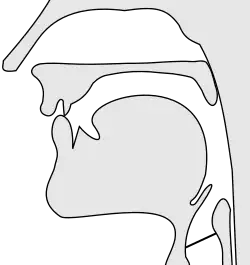
Features of the voiceless labiodental stop:
- Its manner of articulation is occlusive, which means it is produced by obstructing airflow in the vocal tract. Since the consonant is also oral, with no nasal outlet, the airflow is blocked entirely, and the consonant is a plosive.
- Its place of articulation is labiodental, which means it is articulated with the lower lip and the upper teeth.
- Its phonation is un-voiced, which means it is produced without vibrations of the vocal cords.
- It is an oral consonant, which means that air is exclusively allowed to escape through the mouth.
- Because the sound is not produced with airflow over the tongue, the central–lateral dichotomy does not apply.
- Its airstream mechanism is pulmonic, which means it is articulated by pushing air solely with the intercostal muscles and abdominal muscles, as in most sounds.
Varieties
| IPA | Description |
|---|---|
| p̪ | plain p̪ |
| p̪ʰ | aspirated p̪ |
| p̪ʲ | palatalized p̪ |
| p̪ʷ | labialized p̪ |
| p̪̚ | p̪ with no audible release |
| p̪̌ | voiced p̪ |
| p̪ʼ | ejective p̪ |
Occurrence
| Language | Word | IPA | Meaning | Notes |
|---|---|---|---|---|
| Greek | σάπφειρος | [ˈsap̪firo̞s̠] | 'sapphire' | See Modern Greek phonology |
| English | up-front | [ʌp̪ˈfɹʌnt] | 'up-front' | Common allophone of /p/ before the labiodentals /f/ and /v/ (although it is also possible for the labiodentals to shift to bilabial /ɸ/ and /β/, respectively, instead). |
| Slovene | snop vidim | [ˈs̪nɔ̂p̪ ˈʋíːd̪ìm] | '(I) see a sheaf' | Allophone of /p/ before /f, ʋ/. See Slovene phonology. |